Reflections on AI Timelines
I was recently looking at the AI Futures Project’s Q1 2026 timelines and had a couple of reflections. Most of these are things that I already knew, but it’s starting to feel real. AI is advancing rapidly, and drastic changes are on the horizon.
Below is a screenshot of Daniel Kokotajlo and Eli Lifland’s forecasts as of April 2026, as well as two of their earlier forecasts for reference.
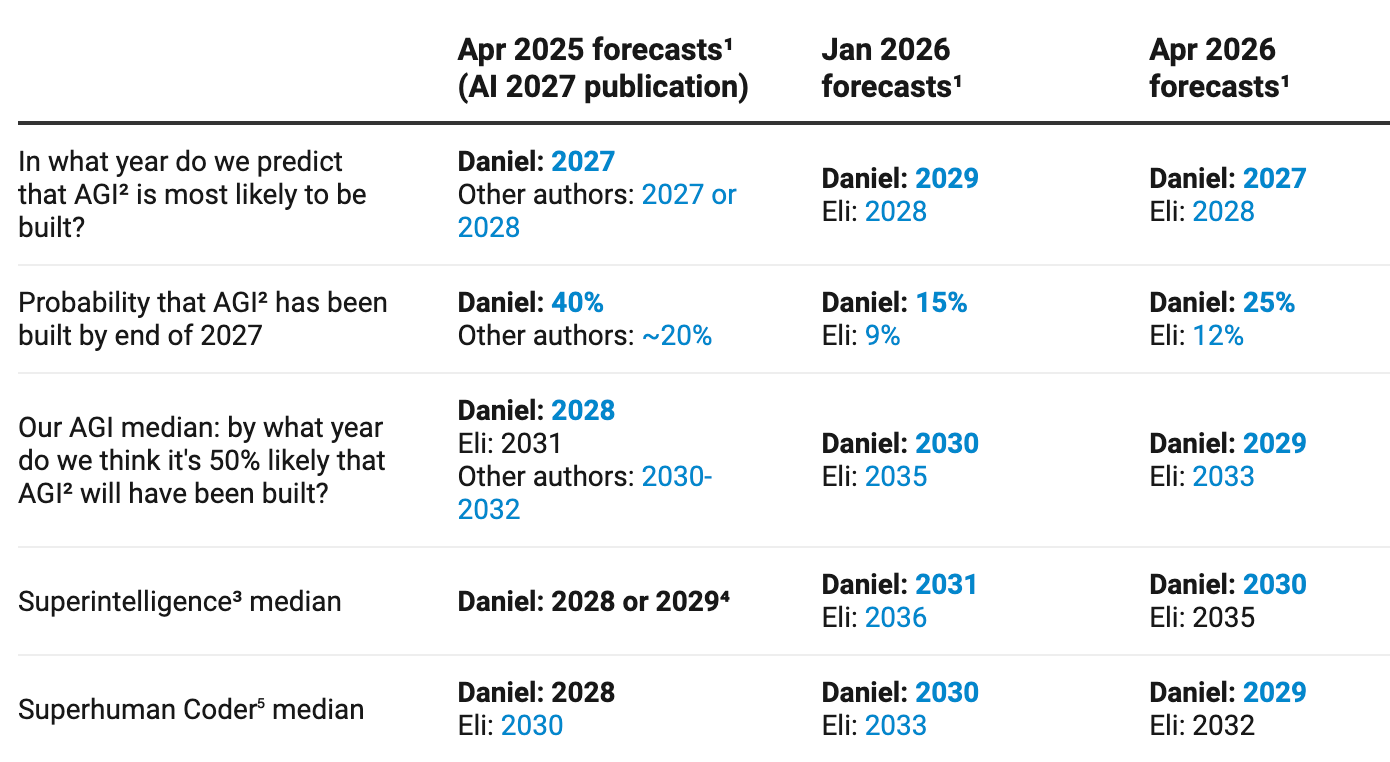
A few things of note. Kokotajlo’s superintelligence median is 2030. He thinks there’s a 25% chance that AGI will be built by the end of 2027—that’s about 19 months away at the time of writing. That’s insane. One of the best forecasters in the world thinks there’s a one-in-four chance that we’ll introduce a species that’s better than humans at nearly every task by the end of next year.
1 Urgency
AI safety interventions are incredibly urgent! There’s a lot that needs to be done before AGI arrives. AGI might cause extinction, so it’s possible that we’re all dead before the end of the decade. Nearly every AI safety expert is worried about this. Even “optimistic” experts think the probability of an AI-caused catastrophe is in the single digits. That’s insane. If some of the most optimistic experts think we have around a 1-in-10 chance of catastrophe, we should be far more alarmed.
It’s important to remember the urgency of the situation. At the time of writing, we might only have 590 days until the arrival of AGI (using Kokotajlo’s end of 2027 estimate). Another estimate gives us just 1,137 days.
We don’t have time to sit around. The most transformative technology humanity has ever built is upon us. Once we build it, there’s no going back. Even if advanced AI doesn’t cause extinction, we might irreversibly lock-in subpar values, permanently destroying future value.
2 Disaster
Every expert is concerned about the risks from AI. Within the next few years, there might be an AI-caused disaster. Millions of people could die. This isn’t a speculative, sci-fi hypothetical spread by AI companies to hype up their product. Normally companies don’t hype up their products by suggesting it will kill everyone. Real human lives are at stake.
Claude’s newest model, Mythos, was so dangerous that they couldn’t release it publicly because it found thousands of undiscovered zero-day vulnerabilities in major software systems. And moving forward, this is the least capable that AI will ever be. Models are improving everyday, at an exponential rate.
Consider people in your life that you don’t see too often, maybe once every couple of years. It’s possible that the next time you see them might be the last.
3 Familiarity
The third reflection is how strange the future is going to be. I don’t think anyone has a good idea of what the future is going to look like. Even the most familiar parts of life may change entirely.
This perspective is quite alienating. I’m a college student, so I’m surrounded by people planning out their futures. No one seems to have even the slightest idea what’s coming! Dario Amodei, the CEO of Anthropic, warned of an oncoming “bloodbath”—the automation of up to 50% of all white-collar jobs within the next five years, but no one even so much as mentions automation when planning their careers.
The traditional story path for a good life is to go to college, get a job, start a family, and eventually retire to enjoy the remaining years of life. AGI disrupts nearly every one of these.
Why go to college if you have 24/7 access to Claude, who knows more about every subject than anyone, and is a superhuman teacher? Of course, that’s assuming there’s even a need for humans to learn. People could decide to learn for the sake of learning, but it might not be necessary anymore.
The same goes for getting a job. Superintelligent AI would be better at all tasks than humans. To me, it seems quite likely that there will be a point in the future where humans no longer need to work.
Social dynamics will be similarly disrupted. AGI will be better than humans at socializing. With the right developments in robotics, there might be AI-human centaurs that can be endlessly tweaked to fit user preferences. Why socialize with humans ever again when you could have a group of robots (that are indistinguishable from humans) keep you company? Maybe AI will make such great entertainment that we don’t even want to socialize anymore.
There are so many unknown unknowns—most of these predictions are likely wrong, since a superintelligent AI would come up with a completely different set of ideas than me. After all, I’m not superintelligent!
Either way, it’s alienating, and a bit sad, knowing that so many of the things people say everyday are outrageously false (maybe ‘outrageously’ is too strong of a word, but that’s how it feels). No, you won’t finish law school and become a lawyer. You won’t get to plan your wedding. You might not even have a wedding. Your life won’t be normal. Even the most mundane things are likely to change within the next few years.
When talking about the future, it feels like every claim should have an asterisk. Something like “I know this isn’t literally true, but if we make the highly unlikely assumption that AI development stops, then…” It’s sad that so many of the goals people work towards are essentially unattainable A lot of my friends (mostly sophomore and juniors in college) want to become lawyers. First, they have to graduate from college and law school, which will take 5 or 6 years. But by that time, Kokotajlo thinks we might have superintelligent AI! It’s impossible to say what the world will look like then, but my guess is there won’t be high demand for human attorneys.
This section might be a bit dramatic. Maybe AI won’t disrupt literally everything. The future might have some traces of the present era. But the point is, no one seems to have any clue what’s coming.
4 Moving Forward
The good news is there is a lot that can be done, and having access to better AI models means that we’ll keep getting more productive.
First, donate to effective AI safety organizations. Consider donating to Alex Bores, the EA Long-Term Future Fund, Coefficient Giving’s Transformative AI Fund, Forethought, or Eleos. This list isn’t exhaustive, but I think these are currently some of the best donation opportunities. My guess is that Alex Bores is the best opportunity but you can read more about it here. If you’re not moved by the drowning child argument, consider that AI might literally end your life, or make it much worse than it is now. If things go well, AI could make your life much better. Either way, if you’re not convinced by the moral obligation to donate, doing so might be in your self-interest.
Second, consider a high-impact career. 80,000 Hours has a ton of resources for getting involved with a high-impact career, and is about to release a new career guide for the age of AI. As of September 2025, there were about 1,100 people working full-time on AI safety. The biggest constraint is talent. For context, Nike has about 77,000 employees. The number of people working on what might be the most serious threat humanity has ever faced is about 1.4% of the number of employees at just one clothing company.
Third, volunteer with Alex Bores’ campaign. He’s running for Congress, is the author of the most successful AI safety bill in the US, and is facing intense opposition from Big Tech lobbies.
Fourth, discuss the risks of AI. Start a blog! Share information about the risks of AI, as well as ways to get involved. The Overton window is shifting, but it might not move fast enough. Politicians need to prioritize AI safety, but have no incentive to do so if 99% of the public is indifferent.
AGI might be here in under two years, and it poses extreme risks that are quite neglected. But the risks aren’t inevitable. There’s a lot that can be done to make the future go well, but it’s going to take a truly large-scale effort.
What will you personally be doing in the next 5 years?